
Sikhism's Enduring Strength - A Personal Reflection on Sikh History Leadership and Survival

When I look at the present condition of the Sikh community, I am both concerned and amazed. On one hand, I see serious weaknesses in our religious institutions, organizations, and leadership. On the other hand, I see Sikhism continuing to survive, grow, and maintain its identity despite these challenges.
This makes me wonder: If Sikhism depended entirely on our present-day leaders and institutions, would it have survived in the condition it is in today?
I believe the greatest strength of Sikhism lies not in its current leadership but in the extraordinary legacy left by Guru Nanak Sahib and the other Sikh Gurus. Their teachings, sacrifices, and history have given the Sikh community a foundation so strong that, despite repeated challenges and internal shortcomings, Sikhism continues to move forward.
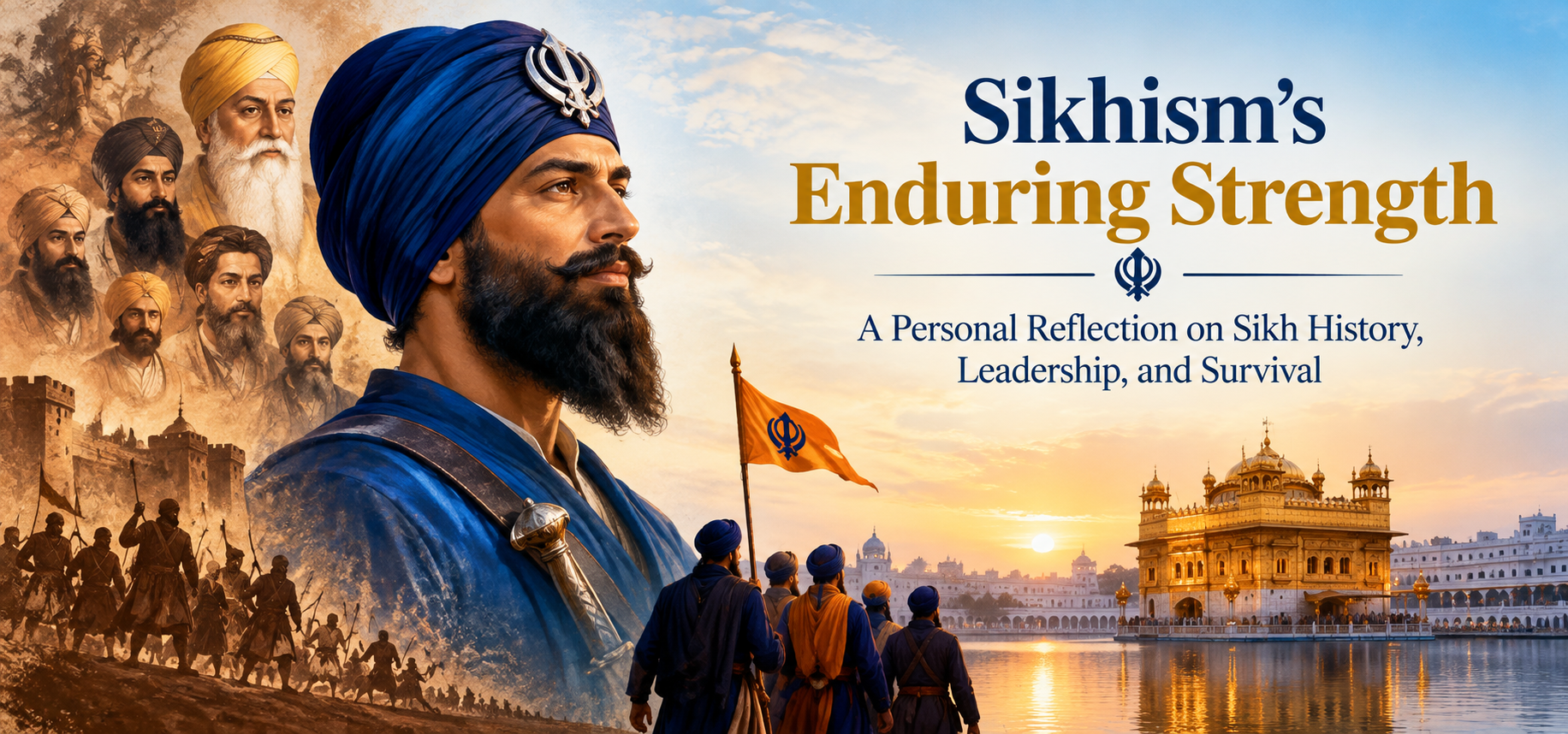
1. The Attempts to Erase Sikh Identity
I often reflect on the idea that there have been attempts to erase the Sikh identity, destroy its historical legacy, and ensure that the community's name and presence disappear. Yet, when I look at Sikh history, I find something remarkable: those who sought to eliminate Sikhism could not bring an end to it.
To me, this demonstrates the extraordinary resilience of the Sikh faith. Sikhism is not merely an institution or an organization that can be destroyed by weakening its leadership. It is a spiritual tradition built on principles, sacrifices, and teachings that have been passed down through generations.
The history of the Sikh Gurus has given the community a foundation that extends far beyond any particular leader or organization. It is this legacy that continues to inspire Sikhs to preserve their identity, uphold their beliefs, and remain connected to their faith.
2. The Four Pillars of Sikhism Appear to Be Weakening
When I examine the condition of the Sikh community today, I feel that the four pillars supporting our religious and communal life have been weakened. Whether we look at our religious traditions, our organizations, our institutions, or Sikhism as a broader community, I see serious challenges.
In my view, these weaknesses have been developing over many years, particularly over the past fifteen years or so. The situation raises important questions about the direction in which our community is moving and whether our institutions are fulfilling the responsibilities entrusted to them.
What surprises me most, however, is that despite these weaknesses, Sikhism continues to survive.
Our institutions may face difficulties, our organizations may struggle with internal divisions, and our leadership may fall short of expectations, but Sikh identity remains alive. Sikhs continue to wear their turbans with pride, Nishan Sahib flags continue to fly, Gurdwaras continue to be established, and religious services continue to take place.
For me, this contrast between institutional weakness and the continued survival of Sikhism is one of the most striking aspects of the community's present condition.
3. Politics Has Become a Major Concern
One of my greatest concerns is the growing influence of politics in almost every sphere of Sikh religious and communal life.
Wherever I look, I feel that political interests have taken precedence over the spiritual and collective responsibilities of leadership. Instead of focusing on strengthening the community, preserving religious values, and serving the Sangat, too much attention appears to be directed towards political calculations and personal interests.
This creates a troubling situation. Religious institutions are supposed to guide the community, preserve its principles, and encourage unity. When political considerations dominate their functioning, the original purpose of these institutions risks being overshadowed.
I believe this problem deserves serious reflection. The question is not simply whether politics has a place in community affairs, but whether political ambitions are being allowed to weaken the religious and moral responsibilities of those who lead the community.
For me, the greatest concern is that the community's spiritual foundation should never become secondary to the pursuit of power, influence, or personal advancement.
4. The Failure of Leadership and the Responsibility of Those Who Lead
When I think about the role of Sikh leadership, I cannot ignore the disappointment expressed in the video. The speaker argues that many people who come forward as leaders of the Sikh community ultimately fail to protect the interests they are supposed to represent.
The image of a boat is particularly powerful here. A leader is like a sailor entrusted with guiding a boat safely through difficult waters. However, if the sailors themselves begin to damage the boat, the very people responsible for protecting it become a source of danger.
I see this as a warning about the responsibilities that accompany leadership. Leadership should be an act of service, not a means of personal enrichment or self-promotion.
When individuals use religious positions or community organizations to advance their own interests, they risk damaging the trust placed in them by the Sangat. The consequences extend beyond individual institutions because the credibility of the wider community can also suffer.
In my view, the Sikh community needs leadership that is guided by humility, accountability, integrity, and commitment to the principles established by the Gurus.
5. Why Sikhism Continues to Survive Despite These Failures
Despite all these concerns, I remain struck by one undeniable observation from the speaker's perspective: Sikhism is still moving forward.
Our community continues to maintain its religious identity. People continue to gather in Gurdwaras, participate in Seva, engage in Kirtan, and preserve traditions that have been passed down through generations.
These practices demonstrate that the community's religious life cannot be understood solely through the performance of its leaders or the condition of its institutions.
I believe this is where the deeper strength of Sikhism becomes visible. Its survival is connected to the teachings of the Gurus, the commitment of ordinary Sikhs, the continuity of religious practices, and the collective memory of generations who have preserved their faith through difficult circumstances.
Even when institutions experience problems, the spiritual connection between individuals and their faith can remain strong.
That is why I find the continued existence of Sikhism so remarkable. The community has faced numerous challenges throughout its history, yet its religious identity continues to endure.
6. The Extraordinary Legacy of Guru Nanak Sahib and the Sikh Gurus
For me, the central message of this reflection is that the history and teachings of the Sikh Gurus are far greater than the shortcomings of any individual leader or institution.
Guru Nanak Sahib established a spiritual path rooted in devotion to the One, truthful living, equality, humility, and service. The successive Sikh Gurus nurtured and developed this tradition, providing the community with a rich spiritual, ethical, and historical foundation.
This legacy gives Sikhism a depth that cannot be measured by the success or failure of contemporary organizations.
I believe the community continues to draw strength from this foundation. The Gurus' teachings offer a source of guidance that transcends political disagreements and institutional conflicts. Their example reminds us that Sikhism is ultimately about living according to principles, serving humanity, standing up for righteousness, and maintaining faith in the face of adversity.
The speaker's reference to the greatness of the Guru's history emphasizes this point: the legacy established by the Gurus is the reason Sikhism continues to survive even when those entrusted with its leadership fail to meet their responsibilities.
Conclusion: Sikhism Is Greater Than Its Present-Day Leadership
When I reflect on all these issues, I arrive at a central conclusion: Sikhism continues to survive because its foundations are deeper and stronger than the weaknesses of its present-day leadership.
I see problems in the way religious institutions and community organizations function. I see the risks created when political interests overshadow spiritual responsibilities. I also recognize the importance of questioning whether those who claim to represent the community are genuinely serving it.
Yet, I do not believe these shortcomings define Sikhism itself.
The teachings of Guru Nanak Sahib and the other Sikh Gurus, the sacrifices of generations of Sikhs, and the continuing commitment of ordinary members of the community have given Sikhism a remarkable capacity to endure.
Our turbans, Nishan Sahib flags, Gurdwaras, Kirtan, and Seva are visible expressions of a much deeper spiritual inheritance.
For me, the lesson is clear: we must not take the survival of Sikhism as proof that everything within the community is functioning well. Instead, we should recognize how much strength exists in the faith itself and ask whether our institutions and leaders are living up to that legacy.
Sikhism does not survive because every leader has protected it. It survives because the foundation laid by the Gurus is greater than the failures of those who came after them.
That, to me, is the real strength of Sikh history—and the reason the Sikh community continues to move forward despite its challenges.

Donate for ParmesharDwar
Send your donations for Sewa and Projects being done by ParmesharDwar Gurmat Parchar Charitable Mission. Use the number below to send using PayTM or Google Pay.

Radio Dhadrianwale 24x7
Listen latest kirtan 24x7 by Bhai Ranjit Singh Ji Khalsa Dhadrianwale
 Apple Podcast Dhadrianwale
Dhadrian wale Mobile Apps


Sangats' Feedback
"Mai Hindu hon to bavjood v mai sant ranjit singh dhadriya wale ji da fan haan, saral te sapast gl krde ne"
Mai Hindu hon to bavjood v mai sant ranjit singh dhadriya wale ji da fan haan, saral te sapast gl krde ne, jo ki har ik nu samjh aa jandi hai.waheguru ji ehna te idda hi kirpa banayi rakhan.
_ Gulshan Dhawan, Pehowa - Haryana
Got something to share? Write us now!
- Kotkapura Case - SIT took statement of Bhai Ranjit Singh Dhadrianwale
- Dhadrianwale cancelled congregation to avoid any deadly resistance from rivals
- Dhadrianwale Conflict - Defamation case filed by Rivals
- Radio Dhadrianwale is Launched
- Dhadriawale gets life threats from taksal spoksperson jassowal
Dhadrianwale Kirtan Schedule
- 1 Feb 2020 - Monthy Diwan Gurdwara Parmeshar Dwar Sahib
- 28-30 Jan 2020 MehalKalan - Barnala Samagam - Dhadrianwale
- 8-10Feb2020 - Joga Mansa Samagam - Dhadrianwale
- 3-5Feb2020 Gidirani Lehragaga Samagam - Dhadrianwale
- 23-25Jan2020 Bhawanigarh Samagam - Dhadrianwale
- 18-20Jan2020 Bhadson Patiala Samagam - Dhadrianwale